
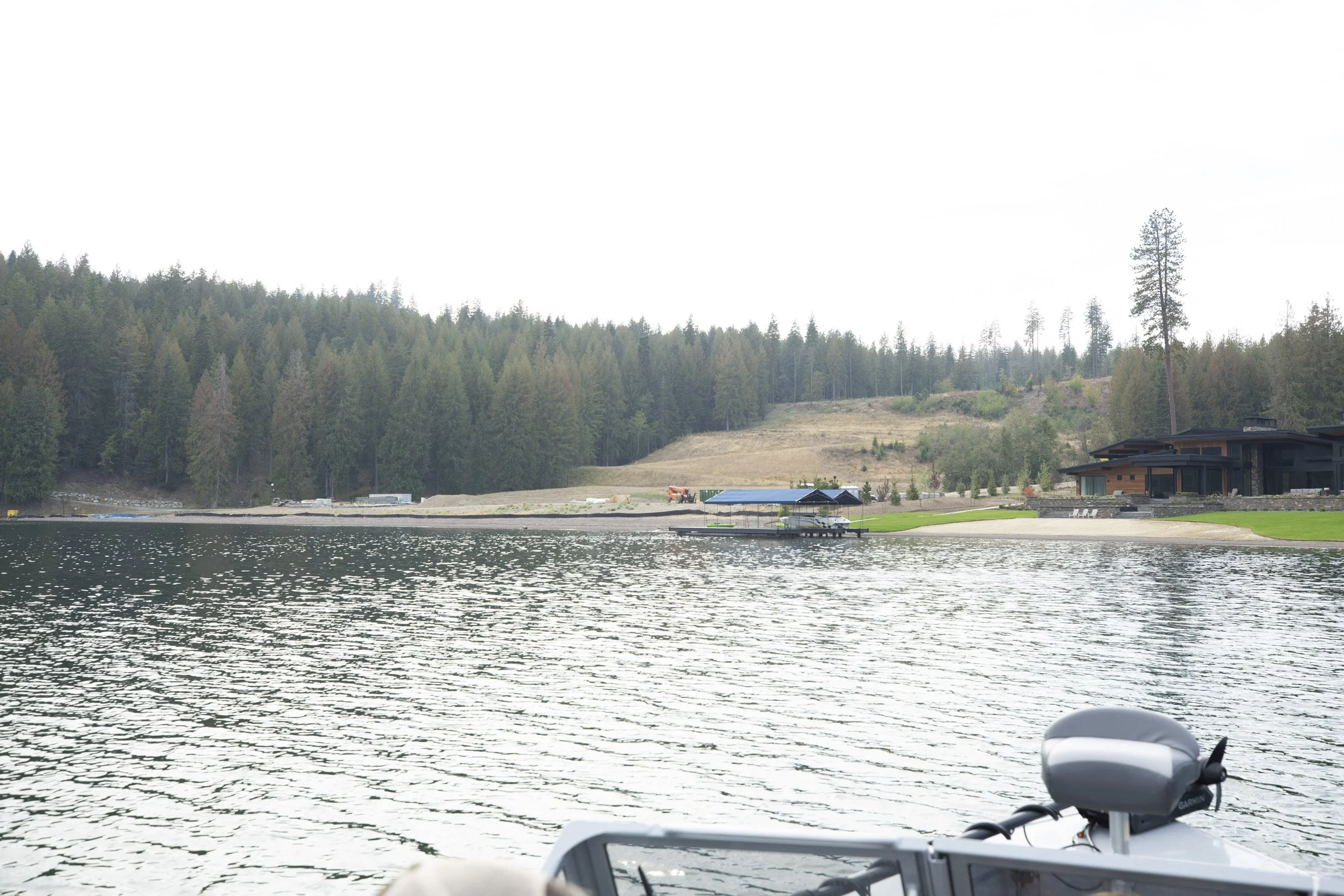
Camp Bay
Amenities
None. 50 feet of waterfront at the end of a short trail.
History
Camp Bay is a rarity in that its earliest records of private ownership belong to a woman.
Anna and Cornelius van Schravendyk emigrated from Uithoorn, Netherlands, to the United States in 1874. In 1901, Cornelius had a stroke in the Dakota Territory, and lost the use of his right hand. The family wanted a place with milder weather for Cornelius, so they moved to Hope, Idaho, to stay with their son Henry, who had built a cabin on Pearl Island. However, Cornelius died before he and Anna could obtain their own land. Anna, as a widow, was eligible to file for a homestead claim. At the time, women who were single, widowed, divorced, or deserted were eligible to acquire 160 acres of federal land in their own name. At the time, a married woman was not allowed to take land in her own name unless she was considered the head of the household. Anna’s claim was granted to her in 1902, located at Camp Bay. Her youngest son, John, homesteaded next to her.
Anna wrote to her sister describing the mild climate, saying that the soil seemed very fertile and she’d been able to grow potatoes “as big as a milk jug.” She also described selling farm wares to early Hope tourists: “As the countryside here is so beautiful, many strangers come here in the summer, sometimes also for their health, they imagine they’ll be strong and healthy here,” she wrote to her sister in 1908. “As you know, rich people have their whims and so they’re walking in our pine-forests, breathing the air and they feel their lungs growing stronger everyday. We are patient with them, they pay well for … eggs and vegetables, but it takes a lot of time, for they have nothing to do and the Americans love talking.” Anna lived on her homestead at Camp Bay until her death on March 14, 1913.
In 1924, Robert Schraeder gave or sold part of the land back to the public, and the public occasionally used the paved right-of-way to the edge of the lake until 2022, when private developers convinced Bonner County commissioners to vacate the last half-mile of county road dead-ending into the lake. A legal challenge and overwhelming public opposition resulted in an agreement that the developer would provide a non-motorized trail and 50 feet of waterfront in another part of the bay, which is why this site exists.
Additional Information and Links regarding Camp Bay Dispute
2021 — Dispute begins
“Camp Bay Road vacation back to drawing board” — Sandpoint Reader, Nov. 23, 2021
overs the first court challenge, the county's April 2021 decision to vacate the final 2,550 feet of Camp Bay Road, the conflict-of-interest issue, and the court's finding that the road was a public road providing access to Lake Pend Oreille.
Read the Sandpoint Reader article“District court unwinds Camp Bay Road decision” — Bonner County Daily Bee, Nov. 23, 2021
Covers the same November 2021 court decision from the Daily Bee's perspective, including M3/Green Enterprises' stated reasons for wanting the road vacated and the development implications.
Read the Daily Bee article“Camp Bay Road dispute prompts cease and desist letter” — Sandpoint Reader
Useful for documenting the escalating dispute over the 50-foot shoreline area and the competing interpretations of where the public right-of-way ends. It also discusses the first court ruling's language concerning the road extending to the high-water mark.
Read the Sandpoint Reader article
2022 — Public-access question becomes the central issue
“Camp Bay beach giveaway disputed” — Sandpoint Reader, Feb. 2, 2022
Extremely useful historical/background source. It covers the original homestead, the 1908 road dedication, historical use of Camp Bay as a public landing, the 2021 vacation, the first court challenge, and the argument over whether the road provides access to the lake.
Read the Sandpoint Reader article“Commissioners set to revisit Camp Bay Road vacation” — Bonner County Daily Bee, Feb. 15, 2022
Covers the court-ordered reconsideration and the legal arguments surrounding the first vacation decision.
Read the Daily Bee article“Camp Bay Road decision left to the courts” — Bonner County Daily Bee, Feb. 17, 2022
Covers the commissioners' second decision and the unresolved question of whether Camp Bay Road actually provides public access to Lake Pend Oreille. It also contains extensive public testimony, including both sides' arguments.
Read the Daily Bee article“BOCC denies Camp Bay Road vacation in second go-round with application” — Sandpoint Reader, Feb. 2022
Particularly useful because it goes into the high-water-mark dispute, the historical road dedication, and why the commissioners ultimately denied the vacation.
Read the Sandpoint Reader article“Sheriff, prosecutor weigh in on Camp Bay Road dispute” — Sandpoint Reader
Important for the period when the public-access dispute became contentious on the ground, including questions about trespassing, the 50-foot shoreline, and whether the public could lawfully use the area.
Read the Sandpoint Reader article“The road is not going to be given up”: Public access to Lake Pend Oreille at Camp Bay at center of dispute — Spokesman-Review, July 17, 2022
Probably the single best mainstream overview of the dispute. It lays out the competing positions, history of the road, 50-foot shoreline issue, high-water mark question, court proceedings, M3's development, and negotiations.
Read the Spokesman-Review article“Camp Bay negotiations break down” — Bonner County Daily Bee, July 30, 2022
Covers the failed negotiations between the Arns and M3 and the competing claims about whether a public beach historically existed.
Read the Daily Bee article“Plans unveiled in Camp Bay access talks” — Bonner County Daily Bee, July 26, 2022
Listed in the Daily Bee's Camp Bay archive and particularly relevant to the proposed compromise/negotiation phase.
See the Daily Bee Camp Bay archive“Camp Bay public access hearing on Wednesday” — Bonner County Daily Bee, Aug. 9, 2022
Covers the court hearing over whether there was legally established public access.
See the Daily Bee Camp Bay archive“Camp Bay hearing awaits judge’s ruling” — Bonner County Daily Bee, Aug. 12, 2022
Focuses on the Arns' claim that the original public road created 50 feet of public beach access.
See the Daily Bee Camp Bay archive“Camp Bay beach issue remanded to commissioners” — Bonner County Daily Bee, Sept. 27, 2022
Important procedural turning point: the court sent the matter back to the commissioners, setting up the December 2022 decision.
See the Daily Bee Camp Bay archive“Facts support public access claims at Camp Bay” — Sandpoint Reader, Dec. 16, 2022
One of the best sources if you're researching the historical basis for public access. It discusses the 1908 road petition, Camp Bay's historic role as a public landing, pre-dam lake levels, the high-water mark, the public-trust doctrine, and the legal arguments for the 50-foot shoreline.
Read the Sandpoint Reader article“County approves Camp Bay Road vacation in third hearing” — Sandpoint Reader, Dec. 21, 2022
Covers the December 19, 2022 decision to vacate the road in exchange for a proposed public trail to the lake.
Read the Sandpoint Reader article“Bonner County commissioners vacates Camp Bay Road to developer” — Spokesman-Review, Dec. 20, 2022
Another important mainstream account of the final 2022 county decision, including the public-access compromise.
Read the Spokesman-Review article“Private landowner wants cut off an important access to this popular North Idaho lake” — Idaho Statesman, Sept. 25, 2022
This is particularly useful for regional context: it frames Camp Bay within the much larger shortage of publicly accessible Lake Pend Oreille shoreline and estimates that losing Camp Bay would eliminate 17% of the publicly owned access roads between Long Bridge and Farragut.
Read the Idaho Statesman article
2023 — Second judicial review
“Petition for judicial review filed after latest Camp Bay Road ruling” — Sandpoint Reader, Jan. 27, 2023
Covers the Arns' second judicial review following the December 2022 vacation decision.
Read the Sandpoint Reader article“Couple calls on court to void road vacation” — Bonner County Daily Bee, Jan. 21, 2023
Covers the Arns' legal challenge and their arguments that the county improperly evaluated M3's petition.
Read the Daily Bee article“New Camp Bay hearing set for Oct. 25” — Sandpoint Reader, Oct. 19, 2023
Very useful for understanding the competing visions of access: the direct historic road versus the proposed half-mile trail, including concerns about accessibility for kayakers, elderly users and disabled users.
Read the Sandpoint Reader article“Camp Bay Road hearing Wednesday afternoon” — Bonner County Daily Bee, Oct. 25, 2023
Covers the oral arguments and competing positions immediately before the court hearing.
Read the Daily Bee article“Judge affirms Camp Bay Road vacation” — Bonner County Daily Bee, Dec. 29, 2023
Major legal endpoint. District Judge Cynthia Meyer affirmed the county's vacation, finding that the proposed pathway constituted guaranteed public access and that the county's decision was in the public interest.
Read the Daily Bee article
2024 — The replacement trail/easement becomes the new dispute
“Camp Bay lake access stalled until trail completed” — Bonner County Daily Bee, June 12, 2024
Important because it documents the transition from the original road-access dispute to the practical question of whether the public could actually use the promised replacement trail.
Read the Daily Bee article“Camp Bay lake access must be timely” — Bonner County Daily Bee, June 23, 2024
A response from Jennifer Arn disputing portions of the previous article and explaining the access advocates' position regarding temporary access during trail construction.
Read the Daily Bee article“BOCC to discuss Camp Bay trail easement” — Bonner County Daily Bee, Oct. 15, 2024
Covers the county's consideration of the actual easement intended to establish permanent public access to the lake.
Read the Daily Bee article“Camp Bay easement tabled after calls from public” — Bonner County Daily Bee, Oct. 16, 2024
Very important. The county tabled the easement after concerns about restrictions on public use, enforcement, private security/gates and M3's control over the trail. The article says public access remained closed at that point.
Read the Daily Bee article“At the absolute 11th hour… we risk renewing litigation after having years of it” — Sandpoint Reader, Oct. 23, 2024
Detailed account of the October 15 county meeting and public concerns about the easement.
Read the Sandpoint Reader article“Commissioners work toward trail easement agreement” — Bonner County Daily Bee, Nov. 5, 2024
Covers the revised easement negotiations.
Read the Daily Bee article“Commissioners approve final Camp Bay trail agreement with conditions” — Sandpoint Reader, Nov. 6, 2024
Likely the most important article for the eventual resolution. It reports the Nov. 5 approval of the easement, the required revisions, the 10-foot-wide easement, permitted bicycle use, and conditions surrounding public access.
Read the Sandpoint Reader article
A particularly useful additional source
Project 7B — “Public Waterways Project”
This isn't a news article, but it is highly relevant if you're researching Camp Bay as part of a broader public lake-access history/project. Project 7B explicitly says the Camp Bay controversy prompted it to identify and map other potentially at-risk public water-access sites around Bonner County. It also describes the historical-access research that grew out of the dispute.
Read Project 7B's Public Waterways Project page